
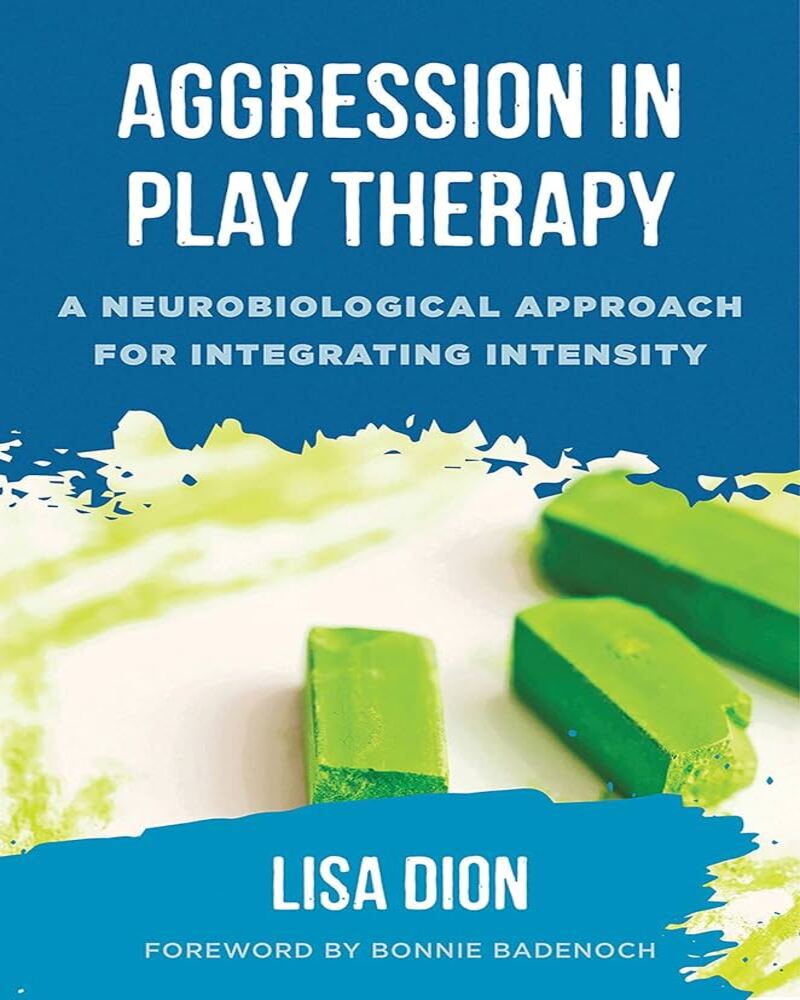
Offers play therapists practical ways of handling a pervasive issue with intense and aggressive play by their clients.
With an understanding of aggressive play based on brain function and neuroscience, this book provides therapists with a framework to work authentically with aggressive play, while making it an integrative and therapeutic experience for the child.
Through the lens of neuroscience and interpersonal neurobiology, therapists are taught how to integrate the intensity experienced by both the child and the therapist during aggressive play in a way that leads towards greater healing and integration. The book explains the neurological processes that lead kids to dysregulation and provides therapists with tools to help their clients facilitate deep emotional healing, without causing their own nervous system to shut down.
Topics covered include: embracing aggression; understanding the nervous system; understanding regulation; developing yourself as an external regulator; authentic expression; setting boundaries; working with emotional flooding; supporting parents during aggressive play.


Luis Z. (verified owner) –
I like the contents of the book. Although its a little advanced for me at the moment. Am sure it in will be of great use in the future.
Paul Berger (verified owner) –
good refernce
Taylor (verified owner) –
Good content.
However can be confusing and dull at parts. I have a petroleum engineering degree and was able to understand most of it. Some parts I had to do some clarification.
Not perfect but definitely a good book for people who need to learn about oilfield chemicals. Good as a reference guide.
Amazon Customer (verified owner) –
good reference
KJB (verified owner) –
A fantastic addition to any play therapist’s library. Pioneering work that successfully blends aspects of play therapy and neurodevelopment in children.
Peter Belfi (verified owner) –
Wow! This opens up a new approach to dealing with ALL too common episodes of aggression with young children in and out of the play therapy setting.
Nancy P. –
I was surprised at how much Lisa’s book had to say to me. I really appreciate that she talks about a difficult subject and “normalizes” the reactions and mis-steps we, as therapists, sometimes take. And then she offers actionable steps that can be taken before, during, and after challenging times in the playroom. The rationale for her suggestions is solidly based in neuroscience and in practice itself and really focuses on the development of the therapist rather than on just another technique. Thank you for the insights, Lisa. I learned a lot and look forward to having more exposure to your work.
Nancy P. (verified owner) –
I was surprised at how much Lisa’s book had to say to me. I really appreciate that she talks about a difficult subject and “normalizes” the reactions and mis-steps we, as therapists, sometimes take. And then she offers actionable steps that can be taken before, during, and after challenging times in the playroom. The rationale for her suggestions is solidly based in neuroscience and in practice itself and really focuses on the development of the therapist rather than on just another technique. Thank you for the insights, Lisa. I learned a lot and look forward to having more exposure to your work.
Keri Anne (verified owner) –
I am not a therapist. I am a parent with some education and training in psychology and mental health care. I am also a trauma survivor with a special interest in traumatology and an autistic parent to autistic children, one of whom is struggling with aggression. After learning about Stephen Porges’ Polyvagal Theory and studying traumatology, it has been hard for me to feel satisfied with most therapeutic approaches available to my family. If a therapeutic approach has not moved forward into the new paradigm, I am not interested. The gap between the old paradigms and the new paradigm rooted in the primacy of felt safety, coregulation, and relationship is far too wide to let my kids or my family be trapped in systems naively doing more harm than good. Know better, do better. First do no harm. Love others as you would be loved. Compassion for others is founded on self compassion (and thus self regulation). I could line up maxims like bowling pins, and in my experience, Lisa Dion’s SPT would be the first approach to aggression in children that bowls a strike. Her approach is deeply humane and compassionate. It is intellectually grounded but not so intellectually dry that it lacks art and intuition. SPT is a marriage of intellect and intuition, body and mind, heart and highly contemporary science.
After a series of experiences with treatment approaches that disrespected my children and caused my oldest son trauma, SPT sounds like manna. At least on paper, this is what I have been looking for. I am excited for us to experience SPT in person. Until then, this book has already helped me with some parenting issues, and I hope Dion has plans to create a book geared towards parent readers. I am comfortable reading a book written for clinicians and extrapolating to parenting. But I know not every parent will be. In the interim, I am glad to see Dion has an online parenting course on her website and look forward to starting it as soon as my husband reads “Aggression in Play Therapy.”
Thank you, Lisa Dion. This work is a treasure. And thank you for your wisdom (even if only stated indirectly) in making this work available to autistic children and not just to children who have survived horrific traumatic experiences or who have mental health issues that have not significantly disabled their development. As Porges’ work and other new research begins to make clear, both autistic children and children with traumatic injuries share similarities when it comes to vagal function, regulation, arousal, etc. Autistic children should not be left out of play therapy but too often they are!! They are then relegated to the realms of treatments that frequently fail to meet their regulation needs. But without safety, without coregulation, without authenticity and congruence in play, how can we expect to support autistic children in becoming their best selves?? We can’t. We aren’t.
I am placing hope that SPT will open new ground for autistic children and families in a service (play therapy) that is usually covered by health insurance. The latter issue of access can be a barrier for other non-ABA play modalities.
“Aggression in Play Therapy” joins my bookshelf next to various texts on yoga and mindfulness as well as the work of Ross Greene, Barry Prizant, Pat Ogden, Stephen Porges, Bessel van der Kolk, Peter Levine, Dan Siegel, Mary Hartzell, Alfie Kohn, Stanley Greenspan, RD Laing, Paul Gilbert, Judith Herman, et al.
Applause, applause. Not only a hit in substance but exceptionally easy to read. To make the theoretical this elegantly clear and digestible is quite the accomplishment.
Customer (verified owner) –
Informative and will opened up my view of aggressive behavior from the nervous system perspective. Lisa offers practical tools and easy to understand the neurobiology of aggression. Lots and Lots of great input that is based in neuroscience. It’s one of those books I keep out and refer to sporadically during the week, to review and remind myself of key aspects to keep in mind.
Diane Bischoff (verified owner) –
Lisa brings another dimension for the therapist while working with expressions of anger in children,
becoming their external regulator. Lisa challenges therapist how to be in the play rather than sitting back observing the play by developing the therapists own awareness self regulation and being authentic in that.
Gem (verified owner) –
Brilliant book. For anyone wanting to understand how to regulate their emotions to work with their client’s emotions. Readable, clear and has really made me think about my own experiences (which i can explore more in personal therapy). Even if you are not currently experiencing aggression in the play room I would recommend it for a basis of any emotion we experience in the playroom. A must read for any play therapist. Thanks Lisa Dion
Lora K Schultz (verified owner) –
This book has been so helpful for me as a parent, therapist, and human being! Lisa is able to explain the brain in a way that is understandable and interesting. Looking at behaviors as symptoms of a dys-regulated nervous system has changed the way I work with children and has helped explain behaviors to other care providers. I highly recommend for anyone interested in learning more about how to help children.
Lora Schultz, ,LCSW
Amazon Customer (verified owner) –
Do you work with children who are aggressive, impulsive, violent? Are you a parent who has a child who struggles with aggressive behavior, can be violent with you, siblings, peers at school? Would you like to change that? If so I highly recommend this book. In the book Aggression in the Play Room you learn how to understand aggression and also depressed withdrawn symptoms too. This book will be a guide for understanding how to see and change the future of our children. This book will be a guide for you to understand how you can support and see the change of our children in the future to decrease aggression and violence.
katie Mathis (verified owner) –
I have ready many, many play therapy books in my career but none like this one! This books brings in neuroscience, coupled with authenticity to create a powerful process of change with a child. Easy to read and explains complicated concepts about the nervous system in practical and understable terminology. When I began to change my own style in the play room based off Lisa’s research in this book, I noticed my clients grow and heal in incredible ways and also began to feel my own brain and body heal at the same time. This is the first book that I recommend to any play therapist!
BHornby (verified owner) –
Very practical and helpful!!!
Joe Willauer –
This is a great resource for therapist, parents or anyone who works with children. Truly though this book can be applied to adults and children being that we all have a nervous system/brain and responses. This book helps individuals to understand the brain and body in a way that feels attainable versus overwhelming. An amazing resources to increase understanding behind behavioral responses which increases connections as well as empathy. 🙂
Joe Willauer (verified owner) –
This is a great resource for therapist, parents or anyone who works with children. Truly though this book can be applied to adults and children being that we all have a nervous system/brain and responses. This book helps individuals to understand the brain and body in a way that feels attainable versus overwhelming. An amazing resources to increase understanding behind behavioral responses which increases connections as well as empathy. 🙂
Amazon Customer (verified owner) –
This book was transformative in my approach to play therapy. It providing a balanced lens to view behavior, practical applications of how I can improve my efficacy when working with children, and the science behind it all. I’ve seen amazing results and recommend the book to anyone who works with children.
Kati Hill, MHS, LPC-S, Registered Play Therapist-Supervisor (verified owner) –
This book has filled in so many of the pieces that I always felt were missing in my practice as a therapist! Lisa Dion, thank you for celebrating authenticity and for giving us all permission to be human!
Malia (verified owner) –
This book is a must- whether you work with child clients or adults. The information put forth answered so many questions for me that I didn’t know I had. I first found Lisa’s ‘Integrating Extremes’ after working several years in a tough urban community. The burnout and compassion fatigue I was facing was scary. Once I learned about hypo and hyper arousal, so much made sense, not only about how my clients were showing up but how I was feeling. I was holding so much but with a blank slate and feeling like I wasn’t moving therapy along. I’ve since left that job but kept looking up more and more Lisa Dion. I would HIGHLY recommend this book to any therapist really. Working with kids and play is tough but this book illuminates so much and gives you, the therapist, permission to own your stuff, name your experience out loud to help the child and yourself regulate. Can’t say it enough- Buy this book and open your third eye!
Amazon Customer (verified owner) –
This book explains some of the missing pieces of doing play therapy. It is a must have for any therapist working with children, teens and families!
Suzanne N. Hall (verified owner) –
Great book and overview of Synergetic Play Therapy.
caroline brennan (verified owner) –
Up there with some of the best books I’ve read for Play Therapy. So practical. Couldn’t recommend highly enough.
Ms D M Roering (verified owner) –
This book is an invaluable treasure trove of theory and practical, realistic strategies to use in the playroom with child clients displaying aggression in their play. A total game changer that I am certain will have far reaching impact on my work with children and their parents as a play therapist. Lisa is immensely knowledgeable, highly recommend this book for anyone working in this field. Thank you Lisa!
Amazon Customer (verified owner) –
This book and the SPT framework offers me regulation as the concepts feel validating and authentic to the way in which I interact with the world. After reading the book I committed to deepening my learning and am currently enrolled in the 6 month intro to SPT course. Lisa’s voice is very soothing so once it’s available, listening on audiobook would also be a nice experience.
Amazon Customer (verified owner) –
This is a very well written book with lots of very important information that all counsellors should know if they work with children and/or parents.
Jessie –
The idea that symptoms are not signs of pathology instead clues to what human needs are craving different styles of regulation. This book offers new ways to connect to self and others with authenticity! Wish I had this in grad school!
Jessie (verified owner) –
The idea that symptoms are not signs of pathology instead clues to what human needs are craving different styles of regulation. This book offers new ways to connect to self and others with authenticity! Wish I had this in grad school!
Tina (verified owner) –
A Must For All Therapists! But especially therapists who use play! Reading is not at the top of my priorities list, so I really enjoyed the audio form of this book!
Sergio (verified owner) –
This books tackles a topic not often addressed in play therapy literature and equips play therapists with practical steps for integrating aggression and working with intense play. An excellent addition to any play therapist’s library!
diana malca-chern (verified owner) –
This book opened my professional senses to a new innovative way of looking at kids in play therapy. The book is a window into a whole new world in play therapy.
Brilliant!
SATeacher (verified owner) –
This book has changed everything about the way I approach my counseling practice with children. It is a new way to think about approaching play therapy that makes counseling sessions simpler and more effective. The author uses her knowledge of neuroscience to explain how the therapist can become an external regulator for the child. The experience becomes one of deep healing and safety.
Amazon Customer (verified owner) –
Mental Health Providers are often so afraid of aggression and try to shut it down immediately in sessions. Lisa’s book invites you to embrace and understand what aggression is, and she demonstrates so beautifully how we are neurobiologically wired to have anger/aggression. This book provides validation and empathy to understanding both our client’s nervous systems and our own nervous systems. This will make you reconsider what you thought you knew about anger, allowing you to have compassion for you and your clients.
Simone (verified owner) –
Wow, what an incredible book!! It is easy to read [loved the little summary at the end of each chapter]. Lisa has written this book in such a way that you don’t want to put it down, so many amazing tips and tricks for working with aggression but also other gems of knowledge. Thank you Lisa for an incredible guide for the PT world.
Chelsea Wright (verified owner) –
This book is a must read for ANY play therapist or therapist that works with children. Aggression shows up in our work whether we like it or not and it is so important that we have a frame of reference for how to work with it. Lisa Dion is a great writer and helps us to understand the importance of aggression and tools to support us.
Kindle Customer –
Eyeopening – show how to attune to a child client when the client is aggressive towards the therapist . Very practical. With numerous examples.
Kindle Customer (verified owner) –
Eyeopening – show how to attune to a child client when the client is aggressive towards the therapist . Very practical. With numerous examples.